
Engineering 3D printing resin is a series of high-performance functional photopolymer materials oriented to industrial manufacturing and product research and development. Different from decorative ordinary resin, engineering resin focuses on practical mechanical properties, including high toughness, high rigidity, heat resistance, impact resistance, and low deformation, which can meet the functional testing standards of industrial parts.
The optimized molecular structure of engineering resin ensures excellent surface finish and stable physical properties after curing. Printed parts have strong bearing capacity, good tensile strength, and outstanding dimensional stability, and can withstand assembly tests, friction tests, high and low temperature environment tests, and structural strength verification. It effectively solves the problem that ordinary photosensitive resin is too brittle, easy to break, and cannot be used for functional experiments.
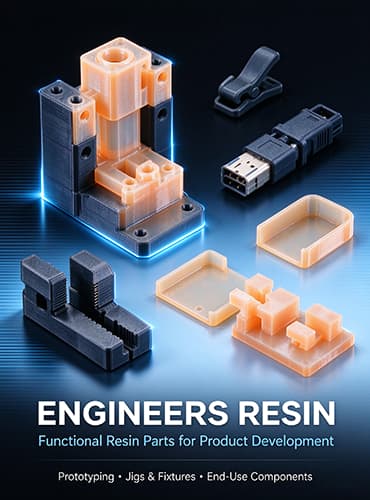
Industrial engineering resin covers multiple performance types such as standard tough resin, high-temperature resistant resin, high-hardness resin, and flexible resin, supporting customized formula development. It is widely used in industrial product prototype verification, fixture and jig customization, electronic shell prototype production, automotive interior part testing, mechanical structural parts trial production, and non-medical equipment auxiliary parts manufacturing. For industrial R&D enterprises, engineering 3D resin greatly shortens product development cycles, reduces mold opening costs, and realizes fast iteration from design drawing to physical verification.